Showing posts with label gamification. Show all posts

Friday, 5 January 2024

Top 10 Gamification Books


Gamification UX books

Dive into the realm of Gamification with our latest article, "Explore Gamification and Top 10 Books." Uncover the power of game elements in diverse contexts and discover essential reads for designers, educators, and business enthusiasts. Join us on this engaging journey to unlock the secrets of effective game design. Some exciting books on Gamification UX, Fun theory and theory of motivation are given below for all gamification lovers. 


Top Gamification UX Books


Bonus

Gamification at Work: Designing Engaging Business

Author: Janaki Mythily Kumar, Mario Herger


What is gamification? Does it belong in the workplace? Are there design best practices that can increase the efficacy of enterprise gamification efforts? Janaki Kumar and Mario Herger answer these questions and more in this book Gamification @ Work. They caution against taking a "chocolate covered broccoli" approach of simply adding points and badges to business applications and calling them gamified. They outline a methodology called Player Centered Design which is a practical guide for user experience designers, product managers and developers to incorporate the principles of gamification into their business software. Player Centered Design involves the following five steps: 1. Know your player 2. Identify the mission 3. Understand human motivation 4. Apply mechanics 5. Manage, monitor and measure Kumar and Herger provide examples of enterprise gamification, introduce legal and ethical considerations, and provide pointers to other resources to continue your journey in designing gamification that works! 


1. Gamification by Design

Author: Gabe Zichermann
What do Foursquare, Zynga, Nike+ and Group on have in common? These and many other brands use gamification to deliver a sticky, viral and engaging experience to their customers. This book provides the design strategy and tactics you need to integrate game mechanics into any kind of consumer-facing website or mobile app. 

2. Actionable Gamification: Beyond Points, Badges, and Leaderboards

Author: Yu-kai Chou

The new era of Gamification and Human-Focused Design optimizes for motivation and engagement over traditional Function-Focused Design. Within the industry, studies on game mechanics and behavioral psychology have become proliferate. However, few people understand how to merge the two fields into experience designs that reliably increases business metrics and generates a return on investment.


3 months IxDF free membership for UX designers


3. Gamification in Education and Business

Author: Torsten Reiners, Lincoln Wood

This book is dedicated to applied gamification in the areas of education and business, while also covering pitfalls to avoid and guidelines needed to successfully implement for a project. Using different theoretical backgrounds from various areas including behavioral economics, game theory, and complex adaptive systems, the contributors aim to help readers avoid common problems and difficulties that they could face with poor implementation.

4. Gamify: How Gamification Motivates People to Do Extraordinary Things

Author: Brian Burke
Buy: Gamify

Organizations are facing an engagement crisis. Regardless if they are customers, employees, patients, students, citizens, stakeholders, organizations struggle to meaningfully engage their key constituent groups who have a precious and limited resource: their time. Not surprisingly, these stakeholders have developed deflector shields to protect themselves. Only a privileged few organizations are allowed to penetrate the shield, and even less will meaningfully engage.

5. Education Gamification: A Quick Beginner's Guide to Getting Started

Author: Hyle Daley

Want to Gamify your classroom? This short guide will help you understand the fundamentals of gaming and how to easily implement it into your classroom. This guide contains information on creating rewards, badges, and how to "Level-Up" your students. Everything is here to get you up and running.


UX EBOOK FREE

6. The Gamification of Learning and Instruction Fieldbook: Ideas into Practice

Author: Karl M. Kapp

Following Karl Kapp′s earlier book The Gamification of Learning and Instruction, this Fieldbook provides a step–by–step approach to implementing the concepts from the Gamification book with examples, tips, tricks, and worksheets to help a learning professional or faculty member put the ideas into practice.

7. Theory of Fun for Game Design 2nd edition

Author: Raph Kostet

Now in full color, the 10th anniversary edition of this classic book takes you deep into the influences that underlie modern video games, and examines the elements they share with traditional games such as checkers. At the heart of his exploration, veteran game designer Raph Koster takes a close look at the concept of fun and why it’s the most vital element in any game.


3 months IxDF free membership for UX designers


8. Gamification - engage customers in your business!

Author: Benjamin Borowski

Are customers now less likely to engage fully in the life and activity of your company?  The old myths about the power of pricing, wide product range, good selling location and frequent promotion aren't pulling in as much profit as before. Average customers are no longer responding to "total sale" or "new product launch" or "available everywhere". They are fed up with that. They become fussier.


9. Gamification: Playing For Profits: A Book of Sales Games and Motivational Tools

Author: Chris Collins

This book is your hack to creating the fun and challenging workplace essential to inspiring your employees to work harder and better together, as your business gains momentum, increases profits, and shows improved overall morale starting tomorrow.


10. Loyalty 3.0: How to Revolutionize Customer and Employee Engagement with Big Data and Gamification

Author: Rajat Paharia
 Buy: Loyalty3.0


Once revolutionary, loyalty programs designed to differentiate products quickly became commoditized and yet, billions of dollars are still spent every year on programs that are doomed to fail. These programs, it turns out, don't inspire long-term loyalty. Once a better deal comes along, customers will gladly defect.


Learn more about Gamification >>


3 months IxDF free membership for UX designers


You may also like

Share:
Continue Reading →

Sunday, 26 February 2023

Psychology in User Experience Design and User research

Psychology in User Experience Design and User research

What is Psychology?

Psychology is the scientific study of mind and behavior. Psychology includes the study of conscious and unconscious phenomena, including feelings and thoughts. It is an academic discipline of immense scope, crossing the boundaries between the natural and social sciences. (Wiki)


Learning about psychology in UX Design

UX designers should learn psychology because it can help them create better user experiences. Understanding human behavior, motivation, and cognition is essential for designing products that meet the needs of users. UX designers need to empathize with their users to create products that meet their needs. Understanding psychology can help designers gain a better understanding of users' thoughts, feelings, and behaviors, which can inform the design process. Psychology can inform user research methods, such as surveys, interviews, and usability testing. Knowledge of psychological theories and concepts can help designers create research questions that provide insights into user behavior and motivation. 


3 Months free Interaction Design Foundation


UX designers often aim to persuade users to take specific actions, such as signing up for a service or purchasing a product. Understanding psychological theories, such as social proof and cognitive biases, can help designers create persuasive designs that are more effective. Understanding human behavior, motivation, and cognition can inform user research, interface design, and persuasive design, leading to products that are more effective and engaging for users.


Role of Psychology in UX Design

Psychology plays a crucial role in UX (user experience) design. UX designers aim to create digital products that are intuitive, easy to use, and engaging for users. Understanding human behavior, motivations, and cognitive processes is essential for designing products that meet these criteria. Here are some ways psychology informs UX design:

  1. User research: UX designers often conduct user research to gain insights into the behaviors, motivations, and needs of users. This research can be informed by psychological theories and concepts, such as cognitive load theory, mental models, and decision-making processes.

  2. User interface design: The design of user interfaces is informed by psychological principles. For example, the use of color, typography, and visual hierarchy can influence user perception and behavior. Understanding how users process visual information can inform the design of interfaces that are easy to navigate and understand.

  3. Usability testing: Usability testing is a critical component of UX design. Psychologists have developed various methods for evaluating user experience, such as usability testing, heuristic evaluation, and cognitive walkthroughs. These methods help designers identify usability issues and improve the overall user experience.

  4. Persuasive design: Persuasive design aims to influence user behavior by appealing to their emotions, motivations, and cognitive biases. Psychological theories, such as social proof, scarcity, and loss aversion, are often used in persuasive design to encourage users to take specific actions.

DISCLOSURE: This post may contain affiliate links, meaning when you click the links and make a purchase, we receive a commission.

Top UX Courses at Udemy


Psychology in Digital experiences

Cognitive psychology principles are combined with cognitive modeling as a way of creating the best possible interfaces. Researchers try to predict user behavior and then design around inherent and anticipated limitations, in order to create an interface that is efficient and intuitive for the users to maneuver and interact with. Psychology is used in digital experiences in various ways to create more engaging and effective user experiences. 

  1. Persuasive design: Psychology is used in persuasive design to encourage users to take specific actions, such as making a purchase or signing up for a service. Techniques such as social proof, scarcity, and loss aversion are often used in persuasive design.

  2. Gamification: Psychology is used in gamification to make digital experiences more engaging and fun for users. Gamification techniques, such as rewards and badges, are designed to appeal to users' motivation and encourage them to engage with the product.

  3. Personalization: Psychology is used in personalization to create experiences that are tailored to individual users' needs and preferences. Personalization techniques, such as content recommendations and personalized messaging, are informed by user data and psychological theories.


Psychology plays a critical role in UX design by informing user research, interface design, usability testing, and persuasive design. By applying psychological principles and theories, UX designers can create products that are more effective, engaging, and enjoyable for users.


Further read: 

What is Cognitive Psychology?


Understand the Elements and Thinking Modes that Create Fruitful Ideation Sessions


Be Afraid! The Silent Role of Fear in Decision Making


3 Months free Interaction Design Foundation


Share:
Continue Reading →

Sunday, 17 September 2017

5 UX talks not to be missed by UX designers

1. Living with Complexity - Don Norman


2. Designing Emotional Experiences - Aarron Walter


3 Months free Interaction Design Foundation


3. Using the Kano Model to Build Delightful UX - Jared Spool


4. Gamification at work - Janaki Kumar


Top UX Courses at Udemy


5. The best interface is no interface - Golden Krishna


3 Months free Interaction Design Foundation


Share:
Continue Reading →

Friday, 20 May 2016

UX Gupshup meetup: Gamification in Enterprise Software

UXness & UX Gupshup have organized a design meetup on 'Gamification in Enterprise Software' at Pune on 7th May 2016. UX Gupshup is amazing way of sharing design and user experience knowledge initiated by Umber Learning Facility.
Presenting the presentation and reference material of event.

About topic

Gamification is the use of game thinking and mechanics in non-game context to engage users in solving problems. In this session we are going to discuss about basics of gamification, game mechanics, enterprise software & why there is need to gamify enterprise software.

Speakers
Shiva Subhedar and Abhishek Jain

Presentation


Special thanks to UX Gupshup & ULF.
Do join UX Gupshup in upcoming meetup events.

Regards,
UXness & UX Gupshup
Share:
Continue Reading →

Saturday, 26 March 2016

Design inspirations from Mario

Tell me one name who has not played Mario game in his/her childhood or not aware about Mario at all. Mario is such a fantastic and famous game of all time. We really enjoyed playing and watching it. Mario game also gives some amazing design inspiration which a designer can take in back of his/her mind while designing. Let’s start with inspirations.

Design Inspirations from Mario game


1.       Visibility of System Status

It is also mentioned as one of the important Heuristic Principles by Jacob Nielsen ‘Visibility of System Status’. It means system should tell its current status clearly. If you see in Mario, there are different looks of Mario signifies different meaning and makes it easier for player to understand the status of Mario. Difference in size and appearance makes clear visibility of status.


2.       Privileged Feeling

Whenever Mario grabs a Mushroom it gets some special privileges and a player can feel those privileges in terms of power, controls etc. Apart from that background music changes to give complete feeling of power and special. In our system we should also take care of our privileged user/customer/members feelings. This inspiration is not limited to a User Interface but one should apply this in their real system.

3.       Excitement vs. Difficulty Balance

For any game it is one of the critical factor to maintain Excitement vs Difficulty balance which Mario is using in very effective manner. For designing any gamified system one should always design complete system by using proper motivations to maintain Excitement vs. Difficulty balance. 

4.       Fun

This is again one important factor for any system to engage their users FUN. If your players or users are getting fun with your product or service, they will be engaged in you. Mario does It by giving micro and big challenges and achievements to a player, also by appreciating player on winning.

5.       Expert vs. Novice user

Design is called good when it takes care of both ‘Novice and expert’ users. Expert users expect more flexibility and customization whereas novice users expect easy availability of information. In Mario for novice players points, powers and obstacles are upfront available and for expert players hidden points, powers and challenges are given, that makes more excitement and engagement for both kind of players.


6.       Error Correction

In a good design, designer always think about error correction and error prevention. In Mario game for each player 3 chances (life) are given, by which player can play the game and if failed in any challenge then he/she can try again.


7.       Simplicity

Simplicity is really complex to design. Yes of course bringing simplicity in design or solution complex thinking and analysis is required. Simplicity of Mario game is one of the major factor for making it successful. A simple graphic, limited controls and easily visible challenges bought simplicity in Mario game design. Her simplicity is not meant by making game easy, I hope designers understand this.

8.       Identity

Mario game has given a best example of branding and identity creation. Theme music and other music of this game are well used in games with consistency so that we all still remember theme music of Mario very well. For any design, product, service, company branding and identity is very important. Be consistent in service better your customers Mario tells you. 

Let’s feel Mario again


About Author:

Abhishek Jain (@uxdabhi)

Share:
Continue Reading →

Sunday, 14 February 2016

Gamification – Basic understanding

What is Gamification

Gamification is the use of game thinking and game mechanics in non-game contexts to engage users in solving problems. Gamification is used in applications and processes to improve user engagement, return on investment, data quality, timeliness, and learning.

Why people play games?


Game elements

What all games are having….

Game mechanics

Important game mechanics which we can apply in non- game systems

- Point system


- Levels


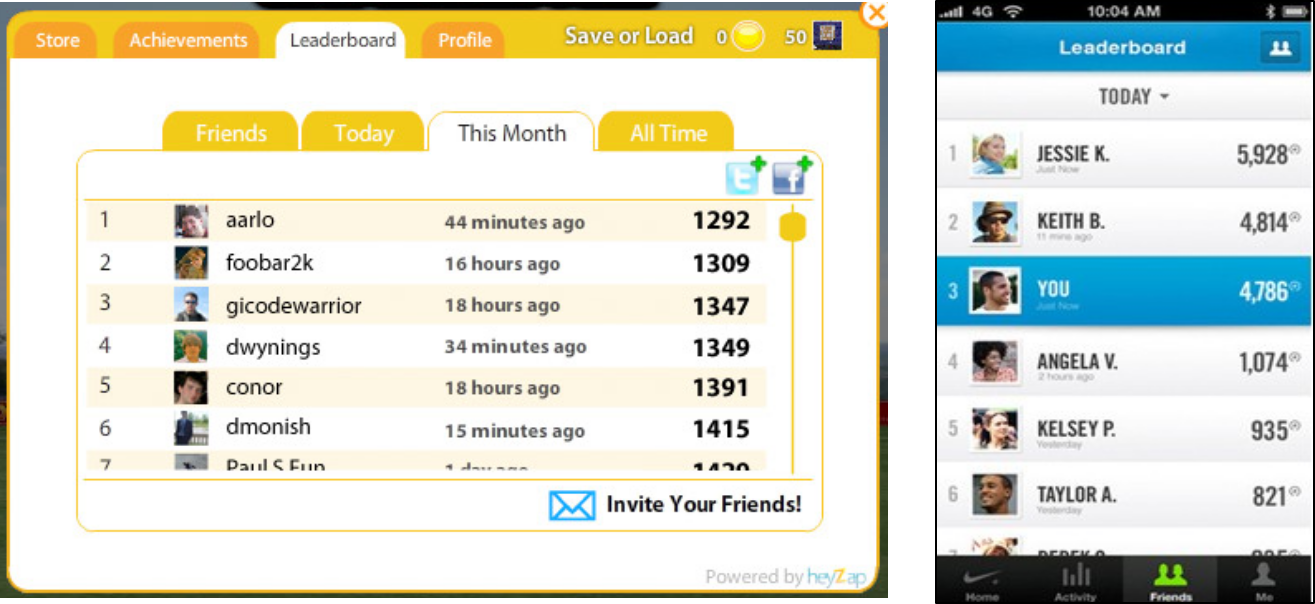
- Leader boards


- Badges

- Challenges & Quests


- Social Engagement loops

Benefits of Gamification

  1. Motivations and long term user engagement and loyalty.
  2. Making things more pleasurable in interaction, process  and in system.
  3. Helps in creating brand connection with user in a meaningful and interesting way.
  4. It can be used with different roles like User, customers, employee and different scenarios like user engagement, personal motivation.         
  5. Helps in converting complex system in to simple and interesting system.

Where we can apply Gamification Techniques

  1. Apply gamification techniques in New System to make it  more easier to learn.
  2. To improve any process like, appraisal, Filling Time Sheet.
  3. To motivate user to perform any task.
  4. In improving working efficiency and process improvement.


About Author

Abhishek Jain (User Experience Designer)


Share:
Continue Reading →

Wednesday, 6 May 2015

Gamification In Enterprise Software

What is Gamification

What is Gamification ?

Gamification is the process of taking something that already exists – a website, an enterprise application, an online community – and integrating game mechanics into it to motivate participation, engagement, and loyalty. Gamification takes the data-driven techniques that game designers use to engage players, and applies them to non-game experiences to motivate actions that add value to your business.
Gamification is becoming a common buzzword in business these days. In its November 2012 press release, Gartner predicted that “by 2015, 40% of Global 1000 organizations will use gamification as the primary mechanism to transform business operations”.

Gamification is Not 

  • Games
  • Making everything a game (any games in the workplace)
  • Any use of games in business
  • Simulation
  • Just for PBLs (Points ,Badges ,Leader board)
  • Game Theory  

Gamification Is

  • Listening to what games can teach us
  • Learning from game design
  • Appreciating fun

What is Enterprise Software ?

Enterprise software refers to software that organisation uses  to run their day-to-day activities such as finance, sales, human resources,etc. Usually the enterprise software are purchase by the companies from other vendors which later they customized, configured in expectation that it would meet there business goals and later these software are made available to their employees.

Why to Gamify Enterprise Software ? 

Entrance of Generation Y in the workforce 

The emergence of  Generation Y (people born from the early eighties to mid-nineties) .They live and breathe online: play, school, and now work. They are accustomed to cutting edge technology & innovation at home, and expect the same quality of technology in the workplace.These new entrants expect more from their workplace than their previous generation.These things are making business to think and understand the unique characteristics of this group, and look for the different ways to  best engage and motivate them.
Author: Shiva Subhedar (@UXDShiva)


Share:
Continue Reading →