Showing posts with label Quiz on Gestalt Principles. Show all posts

Wednesday, 21 February 2024

Gestalt Principles in design

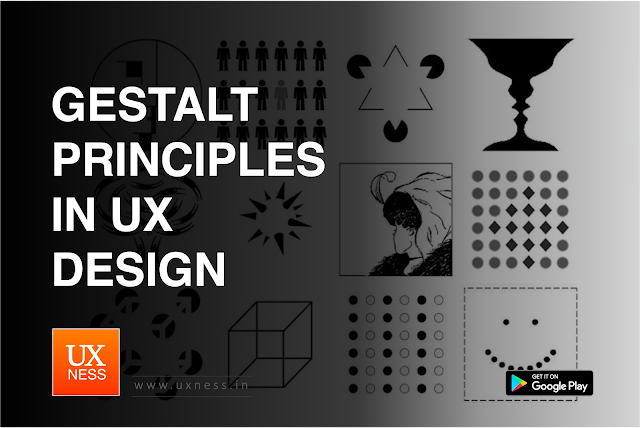
Gestalt Principles in UX Design

Gestalt principles are a set of perceptual principles that describe how humans organize visual information. They can be used to create more effective and user-friendly interfaces. These principles are often applied in various design fields, including user experience (UX) design, to create more effective and user-friendly interfaces.

Gestalt Principles in UX Design:

Proximity

The principle of proximity states that elements that are close together are perceived as belonging together. This principle can be used to group related elements together, such as navigation links or form fields. For example, a website might have a navigation bar at the top of the page with links to different sections of the site. These links are positioned close together to indicate that they are related.

Application: Group related elements together on a user interface to visually communicate their relationship or association.

Similarity

The principle of similarity states that elements that are similar in appearance are perceived as belonging together. This principle can be used to create visual hierarchy and emphasize important elements. For example, a website might use different colors or fonts for different types of content, such as headings and body text. This helps users to quickly scan the page and identify the most important information.

Application: Use consistent colors, shapes, or styles for related elements to indicate their similarity and create a cohesive design.

Continuity

The principle of continuity states that our eyes tend to follow smooth lines and curves. This principle can be used to guide users through an interface and direct their attention to important elements. For example, a website might use a breadcrumb trail to show users where they are located in the site. This helps users to keep track of their progress and navigate back to previous pages.

Application: Use lines or curves to guide the user's eye through related elements or content. This can be applied to flowcharts, timelines, or navigation pathways.

3 Months free IxDX membership for UX designers

Closure

The principle of closure states that our brains tend to fill in missing information and complete incomplete shapes. This principle can be used to create visual interest and make an interface more memorable. For example, a website might use a logo with a negative space element, such as a circle with a missing segment. This helps users to remember the logo and identify the brand.

Application: Create visual connections between separate elements to form a unified whole. This can be particularly useful for navigation menus or multi-step processes.

Figure-ground

The principle of figure-ground states that we tend to perceive objects as being either in the foreground or background. This principle can be used to create contrast and make important elements stand out. For example, a website might use a dark background with light text to make the text more readable. This helps users to focus on the content and avoid distractions.

Application: Clearly differentiate between foreground and background elements to improve visual hierarchy and make important information stand out.

Prägnanz

The principle of prägnanz states that our brains tend to organize information in a way that is simple and regular. This principle can be used to create interfaces that are easy to understand and use. For example, a website might use a grid layout to organize content. This helps users to scan the page and find the information they are looking for.

Application: Logo Design, industrial design, architecture design, photography and art etc.

Gestalt principles can be a powerful tool for creating more effective and user-friendly interfaces. By understanding how humans perceive visual information, designers can create interfaces that are easy to understand and use.


Do you think you know enough about Gestalt Principles? Take this Quiz - Check your knowledge about Gestalt Principles


Further readings

What is Expert Review in UX Design 
What is Contextual Inquiry 


Share:
Continue Reading →

Saturday, 6 May 2023

Check your knowledge on UX design history


UX Design History quiz

User experience (UX) design is the process design teams use to create products that provide meaningful and relevant experiences to users. UX design involves the design of the entire process of acquiring and integrating the product, including aspects of branding, design, usability and function. Interaction Design Foundation

Check your knowledge on UX design history. 


Interaction Design Foundation UX Design course  offer


UX Design History quiz

  1. Which decade is considered the birth of modern UX design?

A) 1970s

B) 1980s

C) 1990s

D) 2000s


  1. Which company is credited with developing the first graphical user interface (GUI)?

A) Apple

B) Xerox

C) IBM

D) Microsoft


  1. Which psychologist is known for his work on cognitive psychology and human-computer interaction?

A) B.F. Skinner

B) Abraham Maslow

C) John Dewey

D) Donald Norman


  1. Which book, written by Donald Norman, is considered a foundational text for UX design?

A) "Designing for People"

B) "The Design of Everyday Things"

C) "The Psychology of Everyday Things"

D) "The Human-Computer Interaction Handbook"


  1. What was the main goal of early interface design?

A) To make interfaces visually appealing

B) To make interfaces easy to use and understand

C) To make interfaces as complex as possible

D) To make interfaces profitable


  1. What is the name of the first web browser that included support for graphics and text formatting?

A) Mosaic

B) Netscape Navigator

C) Internet Explorer

D) Google Chrome


Don Norman UX Course


  1. What is the name of the first mobile phone with a touch screen?

A) Blackberry

B) iPhone

C) Motorola Razr

D) Nokia 3310


  1. What is the name of the design methodology that emphasizes designing for the end user's needs and goals?

A) Agile

B) Waterfall

C) Lean

D) Design Thinking


  1. Which company is known for their focus on user-centered design and design thinking?

A) Apple

B) Google

C) Microsoft

D) IBM


  1. What is the purpose of usability testing in UX design?

A) To identify potential users for the product

B) To validate the product's design with real users

C) To create marketing materials for the product

D) To design the visual look and feel of the product


Match the answers:

  1. C

  2. B

  3. D

  4. B

  5. B

  6. A

  7. B

  8. D

  9. A

  10. B


Share your quiz score in the comments below.


Interaction Design Foundation UX Design course  offer
Share:
Continue Reading →

Sunday, 7 March 2021

Quiz - Check your knowledge about Gestalt Principles

 
Gestalt principles

What are Gestalt Principles?

Gestalt Principles are principles/laws of human perception that describe how humans group similar elements, recognize patterns and simplify complex images when we perceive objects. Designers use the principles to organize content on websites and other interfaces so it is aesthetically pleasing and easy to understand. (Gestalt Principles)


Let’s go for below questions about Gestalt principles and evaluate your knowledge. 


3 Months free Interaction Design Foundation


Quiz on Gestalt Principles


1. Which gestalt law states that when things appear to be similar to each other, we group them together. And we also tend to think they have the same function.


a. Law of Similarity

b. Law of Proximity

c. Law of Common Region

d. Law of Continuity


2. Which gestalt law states that things that are close together appear to be more related than things that are spaced farther apart.


a. Law of Similarity

b. Law of Common Region

c. Law of Proximity

d. Law of Common Fate


3. Which gestalt law states that when objects are located within the same closed region, we perceive them as being grouped together.


a. Law of Continuity

b. Law of Common Region

c. Law of Proximity

d. Law of Common Fate


DISCLOSURE: This post may contain affiliate links, meaning when you click the links and make a purchase, we receive a commission.


UX Design certificate by Google


4. Which gestalt law states that elements that are arranged on a line or curve are perceived to be more related than elements not on the line or curve.


a. Law of Continuity

b. Law of Proximity

c. Law of Common Region

d. Law of Common Fate


5. Which gestalt law states that when we look at a complex arrangement of visual elements, we tend to look for a single, recognizable pattern.


a. Law of Continuity

b. Law of Proximity

c. Law of Common Fate

d. Law of Closure


Top UX Courses at Udemy


Answers: 1- a, 2-c, 3-b, 4-a, 5-d


If you have answered 4 or above questions correct, you have a good sense of principles, if you have 3 or less questions correct, it’s time for you to have a grip on Gestalt principles. Below are some great references to learn about Gestalt principles (Courses & articles). 


Learning Gestalt Principles: 


Top courses to learn Gestalt principles -


Gestalt Psychology and Web Design: The Ultimate Guide


Gestalt Psychotherapy - ACCREDITED CERTIFICATE


Design Theory| "Designer Choice" |The Complete Design Course


Gestalt Theory for Web/UX/UI/App Designers


3 Months free Interaction Design Foundation


Some top articles about Gestalt Principles for reading:


The gestalt principles in web design 


Gestalt Principles


5 Principles of Visual Design in UX


The Law of Similarity - Gestalt Principles (1)


Laws of Proximity, Uniform Connectedness, and Continuation – Gestalt Principles (2)


3 Months free Interaction Design Foundation


Share:
Continue Reading →