Showing posts with label Examples of Gestalt Principles. Show all posts

Wednesday, 21 February 2024

Gestalt Principles in design

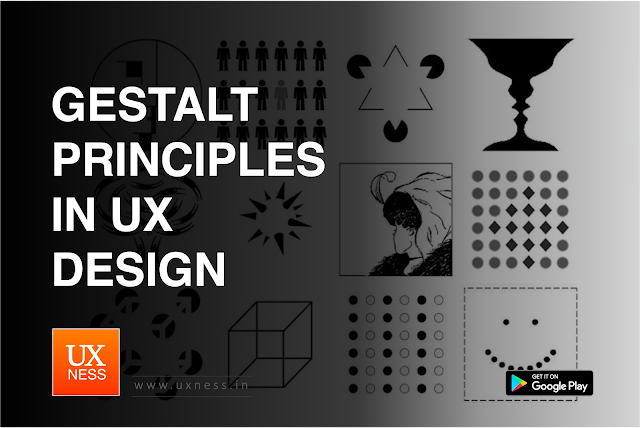
Gestalt Principles in UX Design

Gestalt principles are a set of perceptual principles that describe how humans organize visual information. They can be used to create more effective and user-friendly interfaces. These principles are often applied in various design fields, including user experience (UX) design, to create more effective and user-friendly interfaces.

Gestalt Principles in UX Design:

Proximity

The principle of proximity states that elements that are close together are perceived as belonging together. This principle can be used to group related elements together, such as navigation links or form fields. For example, a website might have a navigation bar at the top of the page with links to different sections of the site. These links are positioned close together to indicate that they are related.

Application: Group related elements together on a user interface to visually communicate their relationship or association.

Similarity

The principle of similarity states that elements that are similar in appearance are perceived as belonging together. This principle can be used to create visual hierarchy and emphasize important elements. For example, a website might use different colors or fonts for different types of content, such as headings and body text. This helps users to quickly scan the page and identify the most important information.

Application: Use consistent colors, shapes, or styles for related elements to indicate their similarity and create a cohesive design.

Continuity

The principle of continuity states that our eyes tend to follow smooth lines and curves. This principle can be used to guide users through an interface and direct their attention to important elements. For example, a website might use a breadcrumb trail to show users where they are located in the site. This helps users to keep track of their progress and navigate back to previous pages.

Application: Use lines or curves to guide the user's eye through related elements or content. This can be applied to flowcharts, timelines, or navigation pathways.

3 Months free IxDX membership for UX designers

Closure

The principle of closure states that our brains tend to fill in missing information and complete incomplete shapes. This principle can be used to create visual interest and make an interface more memorable. For example, a website might use a logo with a negative space element, such as a circle with a missing segment. This helps users to remember the logo and identify the brand.

Application: Create visual connections between separate elements to form a unified whole. This can be particularly useful for navigation menus or multi-step processes.

Figure-ground

The principle of figure-ground states that we tend to perceive objects as being either in the foreground or background. This principle can be used to create contrast and make important elements stand out. For example, a website might use a dark background with light text to make the text more readable. This helps users to focus on the content and avoid distractions.

Application: Clearly differentiate between foreground and background elements to improve visual hierarchy and make important information stand out.

Prägnanz

The principle of prägnanz states that our brains tend to organize information in a way that is simple and regular. This principle can be used to create interfaces that are easy to understand and use. For example, a website might use a grid layout to organize content. This helps users to scan the page and find the information they are looking for.

Application: Logo Design, industrial design, architecture design, photography and art etc.

Gestalt principles can be a powerful tool for creating more effective and user-friendly interfaces. By understanding how humans perceive visual information, designers can create interfaces that are easy to understand and use.


Do you think you know enough about Gestalt Principles? Take this Quiz - Check your knowledge about Gestalt Principles


Further readings

What is Expert Review in UX Design 
What is Contextual Inquiry 


Share:
Continue Reading →

Monday, 13 September 2021

The gestalt principles in web design

Gestalt Psychology


Since time immemorial humans have relied on their tools of perception to survive in this mortal world. From our ancestors always on a lookout for the predators to us checking the road twice before crossing it, we heavily rely on our visual apparatus to survive in this world. To an extent that we can’t even imagine ourselves without it anymore. Our visual perception is the greatest gift of human evolution that took thousands of years to come to its full glory. From a microorganism who couldn’t see anything to an evolved human being, we have come a long way.


To make sense of this world we interact with it, most importantly we observe it. When we see something we try to make sense of it by verifying it with our already existing mental patterns in our memory. After making a successful match, we ‘recognise’ it. The more that ‘something’ comes in front of us, the more concrete the mental pattern for that thing becomes in our mind i.e we learn to recognise it instantly. That’s why the things we interact with daily, we get better at using them. But how do we recognise something? Is there any logic to it? Are there any laws or principles that govern our visual perception? Do these laws apply to our modern gadgets too? Is there any science behind web design? We will try to find answers to these questions via this article. Let's begin.


The Origin of Gestalt Psychology


We are not the first ones who have asked these questions. They must have existed from the times we learned to use our visual apparatus consciously.


Wilhelm Wundt (Aug 16, 1832 - Aug 31, 1920) is regarded as the founding father of experimental psychology. Wundt believed that psychology should focus on the human’s subjective interpretation of this world and should analyse human consciousness under controlled conditions to get a better understanding of the functioning of a human mind. Wundt’s thoughts laid the founding stones for the concept of Structuralism.


Structuralism tried to understand a human mind by breaking it into components and learning the way they are pieced together to generate a complex experience, as well as how they are related to physical and visible events.


Structuralism states that to generate a perception we need to put together the unconscious combination of elements called ‘sensations’ in a human mind. These sensations can be looked at as individual dots in a pointillist portrait (image below) which makes no sense while looked at individually but when looked together we form a meaningful image I.e a human face.


Structuralism gave rise to Gestalt Psychology; A theory of mind that describes human perception according to the ways in which visual information is brought together to form a whole, meaningful objects from individual visual elements.


Founding fathers of Gestalt Psychology


Max Wertheimer along with Kurt Koffka and Wolfgang Kohler came up with Gestalt psychology when they realised that they can’t explain a perception where something is present one moment and absent the next in terms of Structuralism ‘sensations’ idea. This led the founding fathers of Gestalt Psychology to propose; when it comes to human perception ‘the whole is different then the sum of its parts’.


Humans share some common principles when it comes to our sense of perception. In other words, humans are governed by some basic laws of perception that make us perceive this world in a unified manner. Gestalt Psychology tries to unravel that common ground by defining some basic principles that govern our sense of perception. These laws are applicable to everything, from our day to day activities to our digital experience. This makes it mandatory for designers to have an understanding of these underlying principles so that they can design the digital experience in a more relative manner and solve user’s problems in a much more effective way.


The underlying principles of Gestalt psychology


Emergence


Emergence is a key Gestalt principle that talks about the perceptual experience where some meaningful element emerges from a scene without any conscious effort or understanding. Have you ever noticed that face that randomly emerged from that complex pattern on the wall? Well if you did then you have experienced the law of emergence.


Share:
Continue Reading →